Showing posts with label Fes. Show all posts

Monday, May 1, 2017

THE STORY OF DAR ANEBAR, FES (my guest house)


Roof top at Dar Anebar overlooking the medina

When I complained to Ahmed, the owner of the guest house, that I needed to enjoy some distant views as I couldn't see outside, he marched me up to the roof and began telling me the story of his family home that is Dar Anebar and the history of Fes.

Central courtyard from the library
The doorway leads into what was Ahmed's grand-
mother's rooms where she entertained and slept.


These traditional houses are built around a central courtyard and there are no windows in the outside walls. Instead there are windows  facing inwards and they have iron grill work instead of glass.  The design was for privacy, defence/security in the old days, and to keep the house cool in summer and warm in winter. Most had only one door to enter through.


Bab Guissa one minute from the guest house


Dar Anebar was partially built in the late 1800s by Ahmed's grandfather when the medina was growing bigger. At least he built the first floor then. Gradually he added the remaining floors and roof and it was finally complete in 1950!! The dar sits at the edge on the north east corner of the medina (old city) near one of the gates into the city and the ramparts are on its north side. Bab Guissa was, at that time, the main gate, thus Dar Anebar is very accessible from the main outer road and about two minutes walk from the gate. The heart of the medina and its souks lies about ten minutes away through the labyrinth of alley ways. Ahmed is proud that his home is in a quiet clean neighbourhood that is high up with a stunning panorama of Fes and its surrounding hills.

Ahmed grew up in this house along with grandparents, parents, siblings, aunts and uncles, and his cousins. His grandma worked at the nearby Palace Jamai in the 1920s after it was built by a minister of the king to control the city's growth and citizens. It's now a Sofitel and closed for renos.

His home was always filled with relatives, friends, and kids and Ahmed clearly loved his childhood here. But after he finished university, his uncle decided to sell it to some Germans for a holiday home. Ahmed and a cousin were horrified and bought it themselves to turn it into a good guest house. They spent a fortune on renovations, much of it on plumbing and electricity. Once the big house was finished, Ahmed gave a great party to celebrate and his extended family brought him gifts of furnishings from the original home.

Top and left: Tea service in brass
Lower right: orange blossom water dispensers


Dar Anebar is now filled with old family friends, the artefacts of a century of family life here. They include an incense burner, photographs taken long ago, a samovar, a tea service for mint tea, side tables and chairs, and much more.
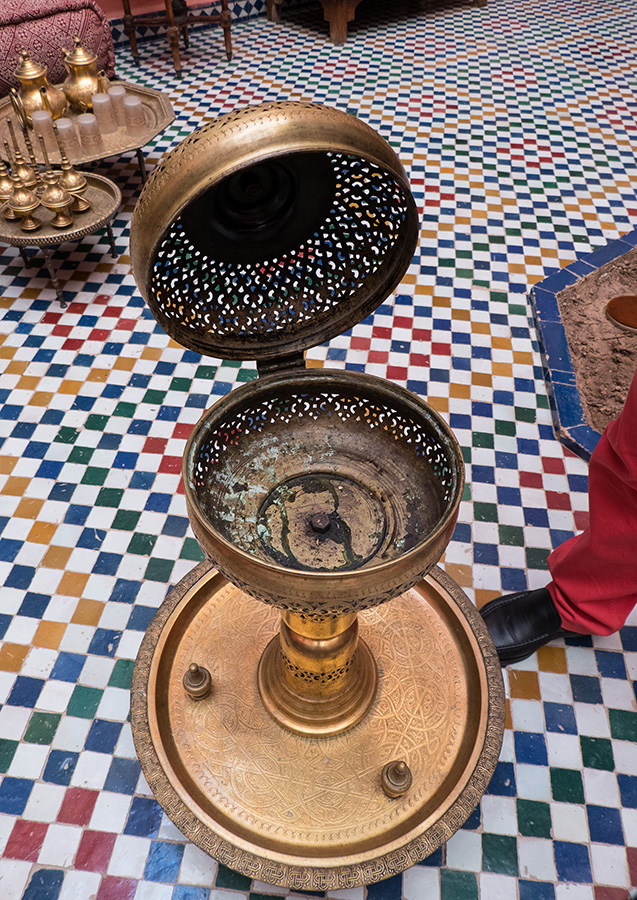
Incense burner- still used


Today, Ahmed is removing the covering above the courtyard that is in place during the rainy season to protect his furnishings and so guests don't get wet while enjoying dinner in the restaurant. Light will pour down into the courtyard in the summer months where the rooms that branch off it were used as bedrooms which were cooler in June, July and August. Now they are breakfast rooms used by all the guests.

In winter, the family moved up one or two floors to get the benefit from rising heat to be cosier. Today these are the guest rooms, each with an ensuite bathroom and efficient AC. Up here is also a long gallery that is a pleasant library overlooking the courtyard with its palm and olive trees and central fountain. Ahmed has hung the old family photos in this gallery that tell his family story. One dates back to 1912 of his grandfather in traditional dress. Others are on display in the courtyard rooms.


The gallery with family photos
Stairs at back right lead to the roof
Ahmed has one guiding principle — he treats his staff and guests as if they are his family. The hospitality is generous and warm in the Moroccan tradition. When I was writing in the courtyard, his young intern from hotel school plied me with mint tea all day, just as guests are greeted when they first arrive along with delicious cookies. Customer service is personal and excellent from everyone here, from the housekeepers to the cook, to the servers, and to Ahmed himself. One day, the housekeeper presented me with my facecloth and underwear that I had washed and hung to dry in my bathroom. She had taken it all and run it through the guest house's laundry for me without being asked! "Much better," she said in French. I have not been allowed to tip for these personal touches.

Ahmed never charged me for all the mint tea I drank or two snacky lunches. Just five nights that also included the best breakfasts I've eaten in over three weeks in Morocco.

If you ever go to Fes, I recommend Dar Anebar to anyone who wants traditional Moroccan hospitality. However don't compare it with the N. American or European 4-5 star hotel chains. It's not the same experience at all — Dar Anebar is a home in the truest sense that welcomes strangers in need of a room.

Visit www.daranebar.com for more details.

ALL IMAGES: © Photos by Pharos 2017. All rights reserved

Sunday, April 30, 2017

MOROCCAN COOKING SCHOOL FOR A DAY: Part Two - the cooking

Lightly searing the lamb with the rub applied
After shopping and for two and a half hours, Lahcen taught me to cook the ingredients for many dishes. They are simple and superb, especially the soup. We prepared:

  • Harira soup, a staple in all Moroccan kitchens
  • Rubs
  • Lamb stew
  • Stock
  • Tomato sauce
  • Vegetable tajine
  • Six spreads or dips as accompaniments
  • Goat cheese canapés wrapped in workah
  • Fava bean salad
  • Dessert escaped us due to lack of time, but it was to be seared apples with cinnamon and sugar, dates, dried grapes on the vine, and a light cucumber salad to cleanse the palate.
First of all, he sat me down with cups of mint tea for a rest as he washed everything and set out our mise en place. The quantities were overwhelming to me, who was used to cooking for one and two. "This will feed four," Lahcen said. More like ten, I thought!

Not all our ingredients!

The riad's kitchen was very basic in comparison to a North American commercial kitchen with eight gas burners in a line and an oven that Lahcen said was too slow and useless. No dish pit and no dishwasher. It was small, about 12x7 feet. Knives were not great and I wished I'd brought my own, and Lahcen laughed at me. Fatima and her helper bustled around us as making lunch for twenty from a tour due to arrive at about 3pm.

First to get going was the lamb, which I trimmed and made a rub with flour and the Moroccan spices. Well coated, I lightly seared it as I chopped onions and sweated them in a pressure cooker. In went the lamb.

Stock pot, with no seasoning


Lahcen was grating the 1.5 kilos of tomatoes for the soup, marinades, and salad dressings, and dropping many things into the stock pot simmering away.

I chopped onions, the herbs, roasted egg plants and peppers over the open gas flame, stirred the soup, swirled the dressings. Lahcen kept saying,"Yallah, yallah!" which meant ""Quick, quick!" He was a typical chef in his kitchen, giving orders and cooking at high speed.


The Harira soup, right, was underway, and I made sure the onions didn't brown, before the stock was added. We made the marinade/sauce for the tajine, poured it over, and popped both over a burner to steam.


The marinade/sauce for the veggie tajine
The fava beans steamed and were dressed with the tomato sauce, lemon, and OO. Delicious, I ate two before Lahcen stopped me!! "Tasting's good, but only one!"

At about 3:30pm we were plating everything but the lamb and tajine. Fatima hugged and kissed me, then up we went to the courtyard to enjoy all our hard work. Lunch was served!

Harira soup and dips/spreads

It truly was a highpoint as the taste was so much better than anything I'd eaten in Morocco. My taste buds were in heaven with all the flavours bursting from every dish.  Not spicy hot but so tasty. I had to pace myself because there was so much to eat and I wanted to savour everything. Soon a server brought up the lamb and the tajine and placed it on the table with a flourish along with some fresh flatbread.

Lamb on left and the veggie tajine
Just after 4:00pm, I couldn't eat another mouthful and sat like a Buddha unable to move.

Lahcen reminded me that everything would taste better tomorrow when the flavours had more time to meld.

What an incredible day!!

.....

For more details about The Fez Cooking and Cultural Tours, visit www.fezcooking.com and do your damnedest to visit Fez to partake of Lahcen's offerings for visitors. He's a gem!

ALL IMAGES: © Photos by Pharos 2017
All rights reserved

MOROCCAN COOKING SCHOOL FOR A DAY: Part one - shopping

The food souk in Fes's medina
After three weeks of eating in Moroccan restos, cafés, and holes in the wall, it was time to learn how to do it. I had found Fez Cooking and Cultural Tours during a Google search months before I left Canada and booked with them. I wanted a company that had a chef teaching the cooking class, rather than a family, and I totally lucked out. Lahcen, the owner of Fez Cooking, operated out of the riad next door to where I stayed in Fes. He also runs an excellent tour company that includes tours of wineries near Meknes which are a legacy of the French protectorate. I wish I had time to do this tour with him.

Lahcen picked me up with a smile at 9:30am and I realized I was his only student. Magic! We drove to the food souk in Fes's medina. On the way he questioned me about the dishes I wanted to cook, what I liked and did not in the way of spices, and my skill level in the kitchen.


The previous downpours were over, and shopping with Lahcen was fun and full of info. He brought along a huge basket like any housewife's and proceeded to overfill it.

For the next hour I was shown how to choose the best ingredients in spice shops, butchers, vegetable and herb stalls. We surveyed the whole souk first and then made our way back buying the food.


"Spices and herbs are the most important ingredients in Moroccan Cuisine," Lahcen said. "Buy fresh spices everyday!"

The basic spices are turmeric, cumin, black pepper, dried ginger, salt, and a mixture of 30-40 spices created by each spice vendor. Their aroma was tantalizing and nothing like their cousins in jars in Canada.


Next came the freshest herbs, hopefully picked that morning in the fields around Fes— parsley, cilantro, and mint in bunches the size of bouquets and two of oregano in posies. And, yes, we used them all. "Use three times more plus, than North American recipes call for," Lahcen advised. He turned out to be correct — it's all about heightened flavour.


In the souk, I saw live chickens, roosters, ducks, pigeons, rabbits, and snails that had been collected in the rain the day before, for sale. Buyers could take the birds home live or have them killed while they watched. (I've refrained from showing you!) Five types of Moroccan bread were on show, as well as workah, a crunchy Moroccan phyllo for pastilla, a chicken pie for special occasions. This was cooked in front of us on a hot stone from a lump of dough spread tissue thin.


Chickens for the pot
Breads made from semolina flour and yeast. Some
had eggs added - top left and right. Roll them up
with goat cheese and/or honey for a delicious breakfast.
Tissue-thin workah that's used like phyllo
Lahcen decided these were the best chickpeas for the soup


Lahcen tasted everything he bought but the lamb. He discarded a couple of offerings from the owner of the cleanest butcher shop in the souk, before buying a lamb shoulder he liked and having it chopped up for the pot.

Laden with our purchases, off we went to his kitchen in a traditional riad to start cooking. See Part Two of the story.

Wednesday, April 26, 2017

MOROCCO IN TWO WEEKS

The red dunes of the Sahara

Today is four days after the whirlwind tour of Morocco that lasted two weeks. It was non-stop places, info, and a new hotel almost every night. Internet was unreliable, rarely available in my room, and sometimes non-existent, so blogging was impossible.

I was wise enough to book four days in a Marrakech hotel at the end so I could breathe freely again and process all that I'd seen and done. I was overloaded with info, had 2000 images in the can, and was fatigued. Thanks to many SPG points, I chose Le Meridien N'Fis to recover. It has been a perfect resort and oasis for my downtime.

Tomorrow I catch the train back to Fes for five nights where I hope to see what I missed in the earlier one-day stop on the tour, and will take in a full day cooking class at the house next door. I may or may not hire a private guide for a morning.

Morocco is the type of country where a solo traveller is better off with a small-group tour. It really is the best way to see everything because, not only do you have a trained tour leader/guide, but also local guides everywhere you stop. I enjoyed my fellow travellers — most were from Britain, one from Australia, three from the US, and me from Canada. All were middle-aged or older, three couples and the rest of us were singles. All were well-educated and very well travelled. Made for great conversations throughout. Many had toured with www.explore.co.uk before — one twenty times and another, fifteen. This speaks volumes for Explore's tours and organization.

We stayed mostly in standard hotels, not luxury properties. This meant being tolerant of deficiencies and no kleenex, facecloths, soap or shampoo. Beds were often like concrete, but no one complained. We had been warned. Our 15-seat bus, was the exception. It was a new Mercedes Sprinter with huge clean windows and AC. We needed the latter when temps rose to 36C inland and in the Sahara. Our driver was cautious and safe in the chaos that are Moroccan roads.

The tour pace was fast so we could see everything Morocco has to offer and to include all kinds of activities and walking tours. We visited all the Imperial Cities, medinas, souks, three mountain ranges (stunning), the Atlantic coast, and the Sahara where we rode camels, met Berber nomads, and listened to a concert.

I shall post more on the individual places later when I have time to better collect my thoughts and sort out the photos.

In the meantime, here are a few images to get you interested:

The third largest mosque in the world at Casablanca — Hassan II. It holds 25,000 of the faithful inside, and 80,000 outside. It is the only mosque in Morocco that is open to non-Muslims and juts out into the Atlantic. Inside, it is even more spectacular than outside.

In the souks, donkey carts and some tuk-tuks are the only way to move goods in and out. This one carries fava beans into Meknes.

Tajines are always for sale in the weekly markets held in most towns and villages throughout Morocco

 The very well-preserved Roman ruins of Volubilis have astonishing mosaics. This is the basilica with the forum in front.

 The huge medina of Fez where there are over 9,400 alleys. Visitors must have a guide here or become hopelessly lost even with a map!

 A butchers in a Fez souk.

 Ilyas, our intrepid tour leader, on the right with Ali, our marvellous local guide in Rassini, near the desert.

 Looking inside a small mosque from a beautiful courtyard.

 Our camels await in Merzouga

Ait Ben Haddou an ancient Berber hill fort where Gladiator was filmed.

At the top of the pass in the High Atlas Mountains, an ancient caravan route for Timbuktu to Marrakech with a long oasis in the valley. About 8,000 feet.

Essasouira on the Atlantic coast. Fishing port and most attractive.

Our hotel in Marrakech was stunning


ALL IMAGES: © Photos by Pharos 2017. All rights reserved.