Showing posts with label Travel. Show all posts

Tuesday, September 19, 2017

IMPRESSIONS OF RUSSIA


Russia's turbulent past, both ancient and modern, influence everything I've seen — the many nations and climates, the Mongol hordes, the Tsars and their expansionism, the Tsars and their internecine murders, the Revolution of 1917, the communist era USSR and its fall in 1989, and the newly independent Russia. It's hard to know where to begin.

Downtown Moscow


Few Russians speak any English. Villages look as if they haven't changed in centuries; wooden homes are often in disrepair; blank faces; fishing shacks along the rivers and lakes. Towns have many buildings of the communist era — grey, forbidding buildings and dirty markets. Cities have modern skyscrapers and gridlock.

Customer service seems limited but is probably d/t language difficulties and lack of travel to other countries where Russians could see how others do it. Perhaps lack of training. I miss the smiles elsewhere. However, it is good on my cruise ship.

Meals are ordinary with lots of root vegetables and soups. Always tasty and well-balanced, but definitely a lack of haute cuisine. Not that I expected that!!

The landscapes are flat and bland along the cruise route.

St. Basil's cathedral, now a museum,
in Red Square, Moscow
The tours from the ship have been excellent, with bilingual local tour guides in every port. We see an overwhelming number of Russian Orthodox churches and cathedrals (too many for the majority of pax), some in use and others turned into museums during the communist era. Here, though, is the history of this nation from medieval times to the fall of the Tsars. The art is staggering in its beauty, especially the icons that have been saved.


IMAGES: © Photos by Pharos 2017
        All rights reserved


Monday, September 11, 2017

PHOTO STORY OF WARSAW'S OLD TOWN


Warsaw's old town was built in the 1600s but was flattened in World War Two by the Nazi and Russian invading armies. It has been recon-structed since to look the same outside and in. The main square seen above and right is where the action isand it's touristy. Some good restos here though.


The cathedral of St. John the Baptist, on the way to the square was also reduced to rubble. Today it's worth a visit — gothic but with some ultra-modern touches that I liked. The stained glass on the north and south walls is superb and contemporary.

I tried to find a pamphlet about the history and windows, but not one was to be found and all the signs were in Polish, so I don't know the details of what I saw.


Especially striking was this modern sculpture of Christ, the shepherd, in a side chapel. I don't know who the side panels represent, but there were only ten — clearly not the apostles. I could not replicate the gold colour in the very poor light. It was stunning.


Walking through the main streets, take a detour into the side lanes. They are devoid of souvenir shops and less colourful, but most attractive. Here's where the residents live.


On a bit further and you reach the two walls of the old town and the barbican or bastion. These were rebuilt in the mid-50s from old etchings using reclaimed bricks from other parts of Poland. It is a huge tourist attraction and worthy of it.


Tucked into an alcove by the barbican's main gate, a painter does well selling his pictures.


This is part of the New Town outside the double walls. Also reconstructed faithfully. These are some of the better homes from the 1600s and there are others close by that are bigger, detached, and of 1700s design -- very elegant homes today.


IMAGES:
©Photos by Pharos 2017
All rights reserved


Sunday, September 10, 2017

POLIN: THE MUSEUM OF THE HISTORY OF POLISH JEWS


Although I expected the Museum of the History of Polish Jews was going to be a somber visit, I wanted to have the experience. Poland is a country sandwiched between Germany and Russia and has been invaded, occupied, and ravaged by expansionist nations throughout its long history. Poles have known cruelty and deprivation on a scale few countries have. The Jews suffered more.


The museum is situated on a grassy square that was the heart of the ghetto in World War Two. I approached it from the east, and found the huge modern museum is overlooked by a 36-foot high, black monument. This commemorates the persecution of the Polish Jews and the uprising in 1943 of the Warsaw Ghetto. It looks like a wall and symbolizes both the ghetto walls and the Western Wall in Jerusalem. On the first side was a bas relief of such misery, one cannot but be moved. It signifies the persecution of the Jews by the Nazis in July, 1942.

On the far side of the monument that faces the museum, is a black sculpture of the Jewish insurgents who rose up to fight their oppressors in 1943. Men, women and children are shown with guns and Molotov cocktails. These are the Heroes of the Ghetto after whom the monument is named. The irony here is twofold: some of the stone used in building the sculpture was stockpiled by the Nazis for their own monuments, and the Russians erected it in 1948. This dominating feature of the site stands on the exact spot where the first clash took place in the uprising.


The museum beyond is a vast glass-cladded, ultra-modern structure, angular and sharp. Visitors are dwarfed by it (left). I tried to imagine what the ghetto looked like from where I stood at the entrance (below). I've read quite a lot about this period in Polish history but, because the site is surrounded by apartment buildings today, I simply couldn't.


The previous day I bought my ticket online for about $7.60 Canadian. This proved to be quite a bargain; so did the audio guide at $3.30. I had to pick an entrance time that prevents lineups and staggers the flow of visitors through the displays.

The museum opened in 2013 and inside is the complete opposite to the exterior. There is not a straight line or a sharp angle to be seen. The walls curve and swoop, sometimes oppressing and sometimes freeing; at times dark and at other moments filled with light.

The image, right, is the entrance hall and the stairs lead down to the exhibits. Security is a serious business here and visitors go through the same process as they do in airports — metal detectors, scanners, bag searches, etc.

Down I went and started at the beginning of the Polish Jews' 1000-year history.

Poland had 3.3 million Jews, the largest Jewish community in the world at the time of the Holocaust. Their ancient ancestors had arrived from western and southern European persecution along trade routes and found a safe place to settle here about 1000CE. By 1500, many lived in organized Jewish communities with laws that protected them and peace from the religious wars in the west. This was their golden age in the Polish-Lithuanian Commonwealth. It lasted until 1648.

The exhibits change from the medieval and later eras to exploring the Jewish way of life and the 18th century of learning and spiritual quest. They also explore the rise of anti-semitism in the Russian Empire. By WW1, a third of the Jewish population had emigrated, most to the USA.

The First World War left Germany and Russia in tatters and the Polish Jews enjoyed a second golden age. We see that cultural shift in politics and the arts, as well as daily life. It was brief.

The Nazis and then the Soviets invaded Poland early in WW2. This section of the museum focuses on how the Polish Jews experienced the myriad laws that separated and isolated them from their countrymen and women into ghettos — 600 across the nation. In 1942 the Nazis began to deport the Jews to Treblinka. In two months, 300,000 were transported from the Warsaw ghetto to their deaths. This exhibit is hard to see and I noticed several visitors in tears. Of 3.3 million Jews before the war, only about 300,000 remained in Poland, now a Communist state.

Many left for the new state of Israel. Those who stayed faced a Soviet anti-Semitic campaign in 1968 that all but eliminated the intellectuals and experts — they too emigrated.

Since the collapse of Communism in 1989, there has been a small renewal of Jewish life and this new museum has been part of it.

The exhibits put faces and names to the events in Poland for me. They tell the stories of real lives: the Jews' resilience and hope, the darkness they endured and despair. Reading took me part way there, but the excellent archival material and artefacts brought me to a whole new level of understanding.

I highly recommend putting a visit to the POLIN at the top of your list if you visit Warsaw. It was an amazing experience — so brilliantly done in every way.

The light shines in:


IMAGES:
© Photos by Pharos
All rights reserved

Saturday, September 9, 2017

FIRST THOUGHTS ABOUT WARSAW

Strains of a Chopin étude accompanied my lunch in the hotel's courtyard delighting me in a quiet green oasis. No sounds of the bustling city of Warsaw intruded as I sipped my Polish beer. I can spell the name of the beer but cannot pronounce it. My server tried to teach me but it was beyond me — ZYWIEC....

I was mulling over what I had seen on the half-day tour that I always take first in any new city. With only two days to explore Warsaw, I found it tricky to decide.

Poles are very proud of their country that has endured much because it is sandwiched between Germany (once Prussia) and Russia. They have suffered much cruelty as regimes have invaded, occupied, and decimated it and its population often. Now Poland is independent and grateful after years of communist rule. All ages know what happened to the 320,000 Polish Jews who were herded to Treblinka in WW2 to be murdered in the gas chambers. They commemorate the Ghetto in several ways.

I've spoken to several young people today and discover they are well informed about their history and don't like the current party in power that is right-wing and undoing much that Lech Walesa and his Solidarity party instituted a couple of decades ago. Immigration and refugees is the main issue here, as it is in many countries.

Warsaw is an odd mix of Communist greyness — some dull buildings remain — surrounded by glass skyscrapers that are ultra-modern.

Frederic Chopin's statue
Parks abound and are well-used. I was especially enchanted by the Park Belwederski that has a wonderful statue of Chopin, a native son. On Mondays talented musicians give free live concerts of his wonderful music. Royal palaces from the 1700s are dotted around the park too, and many canals and lakes beautify them. I didn't get inside as I was on a half-day city tour that did not include entrance to the museums and art galleries.

Most Poles in Warsaw appear to speak English, which is an asset, as I cannot begin to speak Polish. It's a tongue-twisting language that bears no relation to any language I've ever heard before. But they use the Latin alphabet which means I can at least decipher the signs that are the same as on my map.

The Jewish museum that stands where the old ghetto was located in WW2, was tantalizing and I shall return tomorrow.

So was the Old Town. That I shall save for my last day and it will probably take all day too. This has been rebuilt following WW2 when most of it was flattened by the Russians as they poured across the Vistula and turned Poland into a Stalinist country and city. I peeked into the cathedral and was astonished by the modern stained-glass windows; I saw the outside of the Royal Palace with buskers in the square outside; and the museum here calls loudly to me, as do the cafes that line the square. Monday will be the day to go before I leave for Russia on Tuesday.

As always, the best way to explore is on foot. My walking shoes stand ready by the door....

The Vistula river runs north-south through Warsaw


IMAGES: © Photos by Pharos 2017. All rights reserved.
Friday, August 18, 2017

BIG MOVE, BIG TRAVEL


A week after I move to Penticton, BC, 250 miles east of Vancouver, I travel to the UK, Poland, Russia, France, and home via ten days in Ontario. I shall be away for six weeks. Not good planning, but there it is!

The trip is not the problem, but packing for it is. After downsizing and packing twenty-five years' worth of living, almost all my worldly goods will be in storage for nine months while my new condo is finished.  I am staying with my daughter and family in the gap. Regarding winter and summer clothes, some of which I will need, I'm not sure what is packed where.

I tried to pack my usual carry-on for the trip but needed some of the space for items I don't usually take. Another suitcase has clothes for both climates. But, where are my hiking boots? My umbrella. Rain pants? Missing, but buried somewhere.... At least I know where my camera gear is — already in my overloaded vehicle.

I don't recommend moving and travelling so close together, but once I sink into my seat and fly across the Atlantic, I won't care a jot. Travel has a way of shelving problems for the time being.  Hey, I can always buy what I can't locate or forgot....

I'll be posting regularly, Internet permitting, once I get to Poland. I may be half-naked, but I know where my laptop is! I have my priorities after all.

Tuesday, May 9, 2017

DAY TRIP TO TOLEDO, SPAIN

On a lovely sunny morning I was wafting along in one of those high coaches on the autoroute to Toledo. It's only an hour south from Madrid, and two friends had told me it was a must-visit town while I was so close.

San Martin Bridge looking to old Toledo

Toledo is ancient, so ancient no one really knows when it began, although recorded history in 190 BCE shows it was settled by the Romans. Other sources date it as far back as 590 BCE with Jewish residents. The town sits on a  rock in a gently rolling plain and is embraced by the River Tagus acting as a natural moat on two sides. Walls defend the land-facing sides. It is a beautiful sight from one of the bridges across the river, but Toledo's many treasures can only be discovered from inside. I wondered how out of breath I would be once I attained the top of the rock.


I needn't have worried: we used the escalators to reach to top, which are cleverly hidden in stone walls the same colour as the buildings, and so began our walking tour that lasted over two hours.

One of the narrow alleys
The narrow alleys reminded me of the old medinas in Morocco and so they should. In the 700s Toledo was invaded by the Moors who left their mark everywhere. The only difference was that many of the narrowest streets opened up into hidden squares, green with the new leaves of spring and filled with cafe tables. Fortress Toledo benefited from the art and architecture of Islam.
A large square in the old town


The spire of the Gothic cathedral


In 1085, the city was won back after a long siege. The Spanish king, Alfonzo VI fortified it further and enticed more people to make it their home. Toledo became an imperial city. In 1227, a successor began the magnificent cathedral whose spire graces the top of Toledo. The Jews, Christians, and Arabs lived here in peace together.

Later in the 1400s, King Ferdinand and Queen Isabella made it their capital, endowing Toledo with many foundations. The Catholic Monarchs moved around their kingdom more than they resided here and eventually moved to Grenada causing a decline in the town.

This long history was both kind and unkind to Toledo— its fortunes rising and falling over the centuries. Today, 55,000 live here in the new town and the old, and its main industry is tourism. I feel that they have managed the onslaught of visitors quite well.
A craftsmen adds gold wire as thin as a hair


The old sources of income have
been revived such as the Damascene craft (original brought here by Arabs from Damascus) and its work of swordsmiths conducted since the Middle Ages. I also admired the ceramic artistry available in some small shops.

El Greco lived here and painted a celebrated masterpiece for the church of San Tomé in the 1500s. The Burial of the Count of Orgaz is still there today, rich in colour and symbolism. The church was built on the site of an old mosque by Alfonzo VI. Photographs are strictly forbidden.

The churches, synagogue, and mosques still in evidence proclaim the tolerance towards all faiths that Toledo has displayed for much of its existence, apart from the Spanish Inquisition period, which caused many of the Jews to flee to Morocco.
Inside the Santa Maria La Blanca synagogue

This brings us to a very curious place — a synogogue called Santa Maria La Blanca. It was a place of Jewish worship built in the 1100s by Moorish craftsmen that became a Catholic church in the 1500s. Today it still looks like a mosque. But I did find a few Stars of David high on top of some columns, but most had shells which are an Islamic symbol. The altar-piece is definitely Christian. Whatever its origins, this building is tranquil and beautiful.

San Martin Bridge looking to the new town


I walked down the cobblestoned hill towards the River Tagus and onto St. Martin's Bridge that has two fortified towers on either end. Built in the 1200s and restored in the 1300s after the bridge suffered serious damage in a war, it was most recently restored in the 1700s. The views from both sides of the river are worth stopping to admire.

The tower on the new town side of the bridge

I wished I had the opportunity to go inside the huge cathedral and even stay a night or two here. It would be well worth it. Next time, maybe?

ALL IMAGES: © Photos by Pharos 2017. All rights reserved.

SPRING TRAVEL 2017 BY NUMBERS

My spring 2017 expedition is drawing to a close, and I'm writing today during a layover in Paris. I deliberately built this into my journey to a) rest, and b) to get a start on some deadlines. I'm also easing myself into re-entry to my regular home life, something that I occasionally find difficult. However, after five weeks of living out of a suitcase, I've reached the stage of looking forward to being home for a while.

From my hotel window, CDG


This morning, as I watch the big jets landing from N. America at Charles de Gaulle airport, I'm mulling over my five week expedition to Morocco and Madrid. Thinking about the highlights; considering what would have worked better; and remembering the excitement.


Goats in an Argan tree near Essaouira


By the numbers:

  • Days away: 34
  • Flights: 8
  • Trains: 2
  • Bus: 1 for two week tour of Morocco
  • Camel: 1
  • Cities visited: 22
  • Hotels: 17
  • Tours: 5 (one lasted two weeks; others one day)
These figures show a very fast-paced trip, sometimes too fast for me to process or photograph well. Wisely, I did build in some downtime in Marrakech and Fez, but wish I had spent longer in Madrid. I barely scratched the surface here, partly because there is so much to enjoy and partly because I was tired. I need to return, which wasn't in my plans. So next time I'm close to or flying over Madrid, I will stay again.


ALL IMAGES: © Photos by Pharos 2017. All rights reserved.

Monday, May 1, 2017

THE STORY OF DAR ANEBAR, FES (my guest house)


Roof top at Dar Anebar overlooking the medina

When I complained to Ahmed, the owner of the guest house, that I needed to enjoy some distant views as I couldn't see outside, he marched me up to the roof and began telling me the story of his family home that is Dar Anebar and the history of Fes.

Central courtyard from the library
The doorway leads into what was Ahmed's grand-
mother's rooms where she entertained and slept.


These traditional houses are built around a central courtyard and there are no windows in the outside walls. Instead there are windows  facing inwards and they have iron grill work instead of glass.  The design was for privacy, defence/security in the old days, and to keep the house cool in summer and warm in winter. Most had only one door to enter through.


Bab Guissa one minute from the guest house


Dar Anebar was partially built in the late 1800s by Ahmed's grandfather when the medina was growing bigger. At least he built the first floor then. Gradually he added the remaining floors and roof and it was finally complete in 1950!! The dar sits at the edge on the north east corner of the medina (old city) near one of the gates into the city and the ramparts are on its north side. Bab Guissa was, at that time, the main gate, thus Dar Anebar is very accessible from the main outer road and about two minutes walk from the gate. The heart of the medina and its souks lies about ten minutes away through the labyrinth of alley ways. Ahmed is proud that his home is in a quiet clean neighbourhood that is high up with a stunning panorama of Fes and its surrounding hills.

Ahmed grew up in this house along with grandparents, parents, siblings, aunts and uncles, and his cousins. His grandma worked at the nearby Palace Jamai in the 1920s after it was built by a minister of the king to control the city's growth and citizens. It's now a Sofitel and closed for renos.

His home was always filled with relatives, friends, and kids and Ahmed clearly loved his childhood here. But after he finished university, his uncle decided to sell it to some Germans for a holiday home. Ahmed and a cousin were horrified and bought it themselves to turn it into a good guest house. They spent a fortune on renovations, much of it on plumbing and electricity. Once the big house was finished, Ahmed gave a great party to celebrate and his extended family brought him gifts of furnishings from the original home.

Top and left: Tea service in brass
Lower right: orange blossom water dispensers


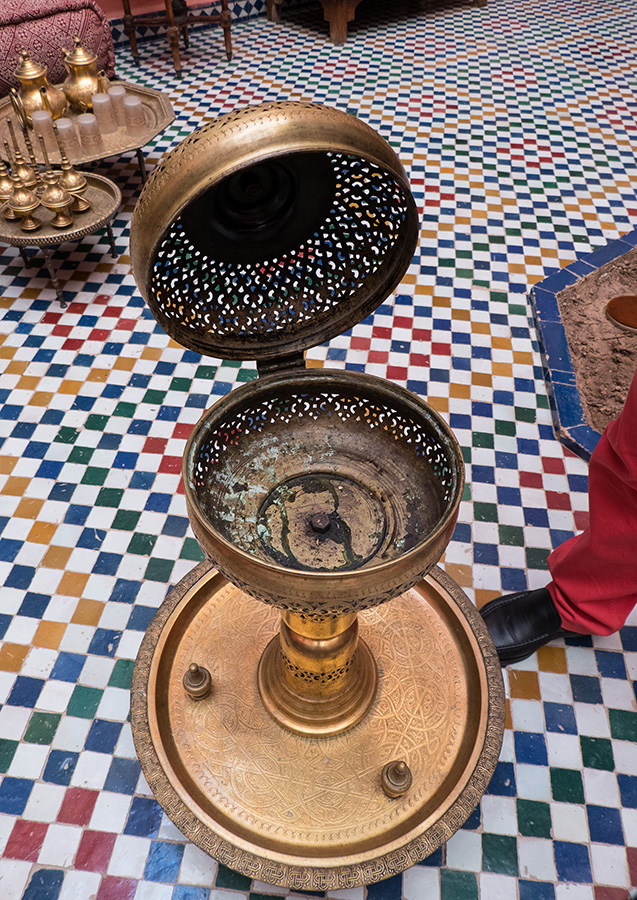
Dar Anebar is now filled with old family friends, the artefacts of a century of family life here. They include an incense burner, photographs taken long ago, a samovar, a tea service for mint tea, side tables and chairs, and much more.

Incense burner- still used


Today, Ahmed is removing the covering above the courtyard that is in place during the rainy season to protect his furnishings and so guests don't get wet while enjoying dinner in the restaurant. Light will pour down into the courtyard in the summer months where the rooms that branch off it were used as bedrooms which were cooler in June, July and August. Now they are breakfast rooms used by all the guests.

In winter, the family moved up one or two floors to get the benefit from rising heat to be cosier. Today these are the guest rooms, each with an ensuite bathroom and efficient AC. Up here is also a long gallery that is a pleasant library overlooking the courtyard with its palm and olive trees and central fountain. Ahmed has hung the old family photos in this gallery that tell his family story. One dates back to 1912 of his grandfather in traditional dress. Others are on display in the courtyard rooms.


The gallery with family photos
Stairs at back right lead to the roof
Ahmed has one guiding principle — he treats his staff and guests as if they are his family. The hospitality is generous and warm in the Moroccan tradition. When I was writing in the courtyard, his young intern from hotel school plied me with mint tea all day, just as guests are greeted when they first arrive along with delicious cookies. Customer service is personal and excellent from everyone here, from the housekeepers to the cook, to the servers, and to Ahmed himself. One day, the housekeeper presented me with my facecloth and underwear that I had washed and hung to dry in my bathroom. She had taken it all and run it through the guest house's laundry for me without being asked! "Much better," she said in French. I have not been allowed to tip for these personal touches.

Ahmed never charged me for all the mint tea I drank or two snacky lunches. Just five nights that also included the best breakfasts I've eaten in over three weeks in Morocco.

If you ever go to Fes, I recommend Dar Anebar to anyone who wants traditional Moroccan hospitality. However don't compare it with the N. American or European 4-5 star hotel chains. It's not the same experience at all — Dar Anebar is a home in the truest sense that welcomes strangers in need of a room.

Visit www.daranebar.com for more details.

ALL IMAGES: © Photos by Pharos 2017. All rights reserved

Sunday, April 30, 2017

MOROCCAN COOKING SCHOOL FOR A DAY: Part Two - the cooking

Lightly searing the lamb with the rub applied
After shopping and for two and a half hours, Lahcen taught me to cook the ingredients for many dishes. They are simple and superb, especially the soup. We prepared:

  • Harira soup, a staple in all Moroccan kitchens
  • Rubs
  • Lamb stew
  • Stock
  • Tomato sauce
  • Vegetable tajine
  • Six spreads or dips as accompaniments
  • Goat cheese canapés wrapped in workah
  • Fava bean salad
  • Dessert escaped us due to lack of time, but it was to be seared apples with cinnamon and sugar, dates, dried grapes on the vine, and a light cucumber salad to cleanse the palate.
First of all, he sat me down with cups of mint tea for a rest as he washed everything and set out our mise en place. The quantities were overwhelming to me, who was used to cooking for one and two. "This will feed four," Lahcen said. More like ten, I thought!

Not all our ingredients!

The riad's kitchen was very basic in comparison to a North American commercial kitchen with eight gas burners in a line and an oven that Lahcen said was too slow and useless. No dish pit and no dishwasher. It was small, about 12x7 feet. Knives were not great and I wished I'd brought my own, and Lahcen laughed at me. Fatima and her helper bustled around us as making lunch for twenty from a tour due to arrive at about 3pm.

First to get going was the lamb, which I trimmed and made a rub with flour and the Moroccan spices. Well coated, I lightly seared it as I chopped onions and sweated them in a pressure cooker. In went the lamb.

Stock pot, with no seasoning


Lahcen was grating the 1.5 kilos of tomatoes for the soup, marinades, and salad dressings, and dropping many things into the stock pot simmering away.

I chopped onions, the herbs, roasted egg plants and peppers over the open gas flame, stirred the soup, swirled the dressings. Lahcen kept saying,"Yallah, yallah!" which meant ""Quick, quick!" He was a typical chef in his kitchen, giving orders and cooking at high speed.


The Harira soup, right, was underway, and I made sure the onions didn't brown, before the stock was added. We made the marinade/sauce for the tajine, poured it over, and popped both over a burner to steam.


The marinade/sauce for the veggie tajine
The fava beans steamed and were dressed with the tomato sauce, lemon, and OO. Delicious, I ate two before Lahcen stopped me!! "Tasting's good, but only one!"

At about 3:30pm we were plating everything but the lamb and tajine. Fatima hugged and kissed me, then up we went to the courtyard to enjoy all our hard work. Lunch was served!

Harira soup and dips/spreads

It truly was a highpoint as the taste was so much better than anything I'd eaten in Morocco. My taste buds were in heaven with all the flavours bursting from every dish.  Not spicy hot but so tasty. I had to pace myself because there was so much to eat and I wanted to savour everything. Soon a server brought up the lamb and the tajine and placed it on the table with a flourish along with some fresh flatbread.

Lamb on left and the veggie tajine
Just after 4:00pm, I couldn't eat another mouthful and sat like a Buddha unable to move.

Lahcen reminded me that everything would taste better tomorrow when the flavours had more time to meld.

What an incredible day!!

.....

For more details about The Fez Cooking and Cultural Tours, visit www.fezcooking.com and do your damnedest to visit Fez to partake of Lahcen's offerings for visitors. He's a gem!

ALL IMAGES: © Photos by Pharos 2017
All rights reserved