Showing posts with label Reykjavik. Show all posts

Tuesday, August 18, 2015

TWO NEW PHOTO PORTFOLIOS: Hebrides and Iceland

I'm proud to announce the publication of two new portfolios recording my explorations of the Scottish Hebrides and Iceland in September 2014.


Three Weeks, Fifteen Islands documents my exploration of the Inner and Outer Hebrides off Scotland's northwest coast. I travelled by land, sea and air from Arran in the south to Lewis in the north. 

Some of the many highlights were a full-day, hands-on photography workshop on Arran and a week's cruise on a converted trawler that visited Mull, Staffa, and Iona, and included a wildlife safari too. Another was landing on the beach at Barra in the Outer Hebrides.


The land steams. Volcanoes erupt. Earthquakes rumble. Mud boils. Geysers gush.

Halló Iceland is the visual journal of my adventures in northern and southern Iceland in late-September 2014. The boon and the curse of seismic activity has defined the land and the people of Iceland since the mid-800s. Its natural beauty is breathtaking, sometimes desolate, and always revealing....

© Photos by Pharos 2015. All rights reserved.

Sunday, September 28, 2014

LEARNING ABOUT THE AURORA BOREALIS


The Northern Lights can only be seen in Iceland during the darker months between the autumn and spring equinoxes. I was there at the end of September, which is one of the best times for this phenomenon. However, I didn't see them; not because of cloud conditions but due to long day tours that had me exhausted. It was not of prime importance as I had already seen the aurora borealis at their best in rural Canada in a display of many colours weaving over the sky for about 40 minutes. Here the colour is mostly green.

Many of those on our tours were mad keen to go out at night, well away from the city lights, and observe them. The tour companies here are experienced in the best spots to view the lights and make every effort to ensure visitors see them.

For those that are unlucky, I would suggest that they visit a new exhibit, Aurora Reykjavik, down by the harbour and close to the Maritime Museum. It is not a big place, but especially informative about sun spots and how they cause the lights.


Northern European countries have many ancient explanations about the aurora that will make you smile. Alongside that is the scientific explanation with excellent diagrams, images, and a video. In the small theatre, a time-lapse movie of some sightings around Iceland runs continuously, so visitors can see what they've missed.

A photo of a photo!
The last section is devoted to how to photograph the Northern Lights, which are demanding as they occur at night. Tripods are essential, of course. Aurora Reykjavik have set up a means for photographers to try it out and it's very helpful. I was able to find out exactly the settings I need to use for my Nikon prime 35mm and kit 18-55mm lenses. Phone cameras won't work too well!

This is an interesting visit for adults, but I feel not really suitable for children under 14.


Cost: Adults, 1,600ISK; students, seniors, 1,400ISK; 6-18yrs, 1,000ISK.
Small gift shop and café with free tea and coffee.

Eielson Air Force Base, Alaska — The Aurora Bo...
Eielson Air Force Base, Alaska — The Aurora Borealis, or Northern Lights, shines above Bear Lake (Photo credit: Wikipedia)
 IMAGES: Except the last image, © Photos by Pharos 2014. All rights reserved

Saturday, September 27, 2014

THE SPLENDOUR OF SOUTHERN ICELAND

 Today brought a major tour with a highly recommended small tour company. They use only small Mercedes vans and wash their windows everyday.

GeoIceland operates out of Reykjavik and offers most of the popular tours. However, our guide Baldvin added a few extras on the Golden Circle tour for us. This meant we detoured through craggy mountains east of Reykjavik to Lake Pingvellir along a small road that was built to service the new hot water pipeline supplying Reykjavik. No traffic, no tourists here.

Hot water pipeline at lower left


Iceland's geothermal geology provides unlimited hot water for everyone and heats 90% of the homes using radiators. It also supplies every settlement with 29C water for their outdoor swimming pools, which are social centres rather like pubs and are open all year. Everyone swims here.


I took the chance to examine some of the flora that grows on the lava rock in the south. Moss, reindeer lichen, and the low-growing wild blueberry bush. The patches of lava that looks like coal are eventually covered with moss, mosi in Iclandic. The moss is everywhere and very thick. It's just like a cushion to sit on, and when you stand up, it springs back into shape. The reindeer lichen are light coloured plants that are about two inches high and branch out like twigs. No reindeer here, but there are imported herds in the east of Iceland.


The road meandered around Lake Pingvellir on the way to Pingvellir, Iceland's national shrine and UNESCO World Heritage site. This is also a national park and is a must-visit, despite being over-run with tourists in the summer. I saw the area with only a handful.

Pingvellir is in a wide rift valley between the North American and the Eurasian tectonic plates on the Mid-Atlantic Ridge, which are pulling apart a few millimetres each year; it has grown wider by 70m in the past 10,000years. The valley is fractured by fissures in the rock. This is an area of high volcanic activity.

However, the main significance for Icelanders is this is the place where Iceland was born. Settlers arrived in growing numbers after 870CE and soon needed a form of government. A general assembly met here for the first time in 930CE, and later its highest court was established. An important decision was made – the Icelanders converted to Christianity in 1000CE. The fields where the Icelanders met can be seen at the far end of the rock split (right). Close by to the south is a river delta which opens into Lake Pingvellir (below).


Driving further east, we came to one of Iceland's most visited geothermal spots at Geysir. Here the sun came out and I watched Strokkur, the biggest geyser erupt repeatedly. There are also smaller, less dramatic geysers, hot pools and streams. The water temp is about 90C and signs warn visitors that the nearest hospital is 62 kms away. Still, I saw many dipping their fingers into the water to see if it was true; also a few were walking outside the marked paths – they were lucky not to disappear in a deep crack or a hidden pool. Along the way on this eight-hour tour there were stops for bathroom breaks, photo ops, and I ate a delicious lunch at Geysir. There are two restos here: one fast food place, and one with a sumptuous buffet serving Icelandic specialties and has a superb view.


After lunch were more waterfalls. Gullfoss is a huge favourite. It's actually two waterfalls that thunder down a gorge at right angles to each other. Between the two parts a cliff juts out where tourists stand and get drenched with spray (left of centre). There are two other viewpoints – one high above and one lower down that looks upstream.

Faxi is smaller and has a salmon ladder. Unfortunately Iceland's efforts to introduce Atlantic salmon failed, so the ladder works but has never seen a salmon leap upstream.

I spied Langjokul, Iceland's second largest glacier (and 600m thick) between mountain peaks and hundreds of sheep corralled for shearing as we turned for home. We stopped at a small town near the southern coast where a recent earthquake ripped apart several houses. Underneath the small shopping centre is a huge crack that can be seen under glass. There is also an exhibit of the damage, but to someone from western Canada, it was a bit tame. Driving through the mountains, dozens of steam vents could be seen as well as the largest power plant supplying all Reykjavik's hot water nestling below the peaks.

I am very grateful to GeoIceland and Promote Iceland for making this exploration of the geology and landscapes east of Reykjavik possible.

IMAGES: © Photos by Pharos 2014. All rights reserved

Thursday, September 25, 2014

REYKJAVIK: FIRST IMPRESSIONS

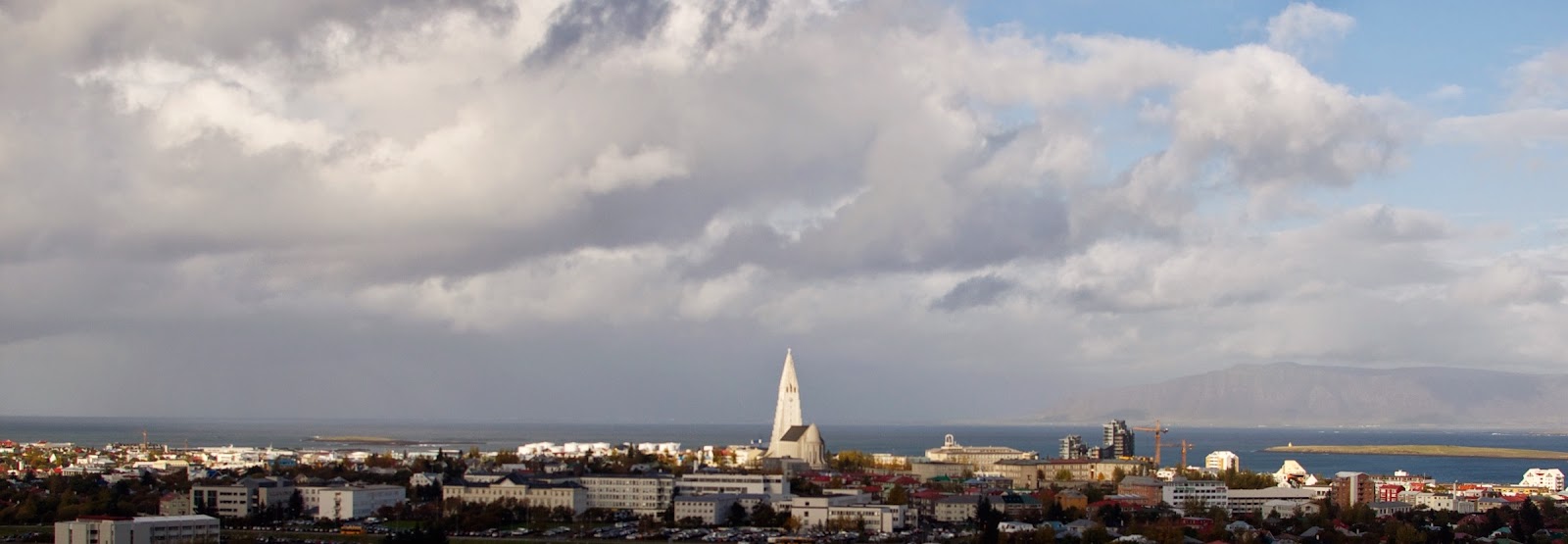
Reykjavik's skyline from Perland

After a typical Iceland cold breakfast of toast, hard boiled egg, and cold meats, we meandered along the main shopping street from our hotel, the Center Hotel Skjaldbreid. We set off at 10am when the stores opened and it was very quiet,
though I noticed it was busy at 5pm and later. Everything is expensive here. A glass of ordinary wine is over $10, as is a bottle of beer (beer on tap is cheaper). The stores were upmarket fashion boutiques and costly Icelandic wool shops. However if you buy more than $40 worth per day, visitors get 25%% taken off on departure at the airport. Sweaters run up from about $180 each, but have been knitted by professional knitters around Iceland. Along here are cafés, bistros, winebars, and coffee shops that are packed morning, noon, and night.


We took a three hour city tour with Reykjavik Excursions to get oriented this afternoon. I felt it could have benefited from omitting the industrial areas and some of the neighbourhoods and been finished in two hours. The guide was good, but no one assisted those passengers with mobility challenges. The steps into and off the bus were deep and did not have handrails on both sides. One old boy from Newfoundland was unable to get off the bus once he was on it. This was a pity as we had three stops en route to visit a museum, Perland, and the cathedral.

I did enjoy the Lutheran cathedral built in 1940 on a hill with a commanding view of the city – it's modern, airy, and graceful outside and in. The organ is astounding with over 5000 pipes, but they are fundraising in order to clean each one.


I liked the look of the old part of Reykjavik, close to the harbour, which has been operating for several hundred years. I plan to poke around and eat lunch there on Saturday. The fishing harbour is close by and today also has a lively whale-watching industry.


The two tour highlights for me were Perland and the famous Viking sculpture on the waterfront. Perland is unusual – it is built around and on top of four gigantic water tanks kept filled for the city in case of an emergency. Inside is a geyser that erupts every few minutes, but upstairs is a 360 degree view platform around the glass dome that houses an excellent café. One floor up is an award-winning resto that rotates. The skyline up here is worth seeing alone, but the architecture is superb inside and out. Brilliant design to disguise the water tanks.


However it was the steel sculpture on the waterfront that knocked my socks off. It's huge and captivating in its simplicity. Vikings discovered Iceland in the late 800s CE and you can still recognize the genes in some stocky, red-haired citizens.


Dinner was also a delight tonight. In a very French bistro we had Icelandic lamb stew served in a small saucepan. It was so tender the meat fell apart. As is so common here, it was served with potatoes and root veggies. Not much else can be grown in this climate. And so ended our first full day in Reykjavik. Not a bad one at that!!

IMAGES: Photos by Pharos 2014. All rights reserved