Showing posts with label Inner Hebrides. Show all posts

Tuesday, August 18, 2015

TWO NEW PHOTO PORTFOLIOS: Hebrides and Iceland

I'm proud to announce the publication of two new portfolios recording my explorations of the Scottish Hebrides and Iceland in September 2014.


Three Weeks, Fifteen Islands documents my exploration of the Inner and Outer Hebrides off Scotland's northwest coast. I travelled by land, sea and air from Arran in the south to Lewis in the north. 

Some of the many highlights were a full-day, hands-on photography workshop on Arran and a week's cruise on a converted trawler that visited Mull, Staffa, and Iona, and included a wildlife safari too. Another was landing on the beach at Barra in the Outer Hebrides.


The land steams. Volcanoes erupt. Earthquakes rumble. Mud boils. Geysers gush.

Halló Iceland is the visual journal of my adventures in northern and southern Iceland in late-September 2014. The boon and the curse of seismic activity has defined the land and the people of Iceland since the mid-800s. Its natural beauty is breathtaking, sometimes desolate, and always revealing....

© Photos by Pharos 2015. All rights reserved.

Friday, May 1, 2015

WINTER WAS SPENT WRITING ABOUT MY TRAVELS

Scarinish, Tiree
In the first four months of 2015 I enjoyed a publishing bonanza with my travel articles and images from the Scottish Hebrides and northern and southern Iceland  – to read them, click on "My articles" above or visit my website. On the strength of these, four more requests brightened my inbox.


Crofter's cottage
Future plans include: In mid-May, I visit Galiano Island for some photography and relaxation after a stressful six months of health challenges. After that, it's off to the Travel Media Association of Canada's 2015 conference in Peterborough, ON, followed by a river cruise to Georgian Bay with Ontario Waterway Cruises and a visit to Montebello, Quebec.

And later, my husband and I are planning a five week road trip in September to explore places we've never seen in Washington State, Oregon, and northern California.
Trekking to Solheimajökull, Iceland

All images:
 © Photos by Pharos 2014. All rights reserved

Wednesday, September 10, 2014

SMALL-SHIP CRUISING IN THE HEBRIDES (Part 5): THE SACRED ISLE OF IONA

Anchorage off Isle of InchKenneth
as the sun rose
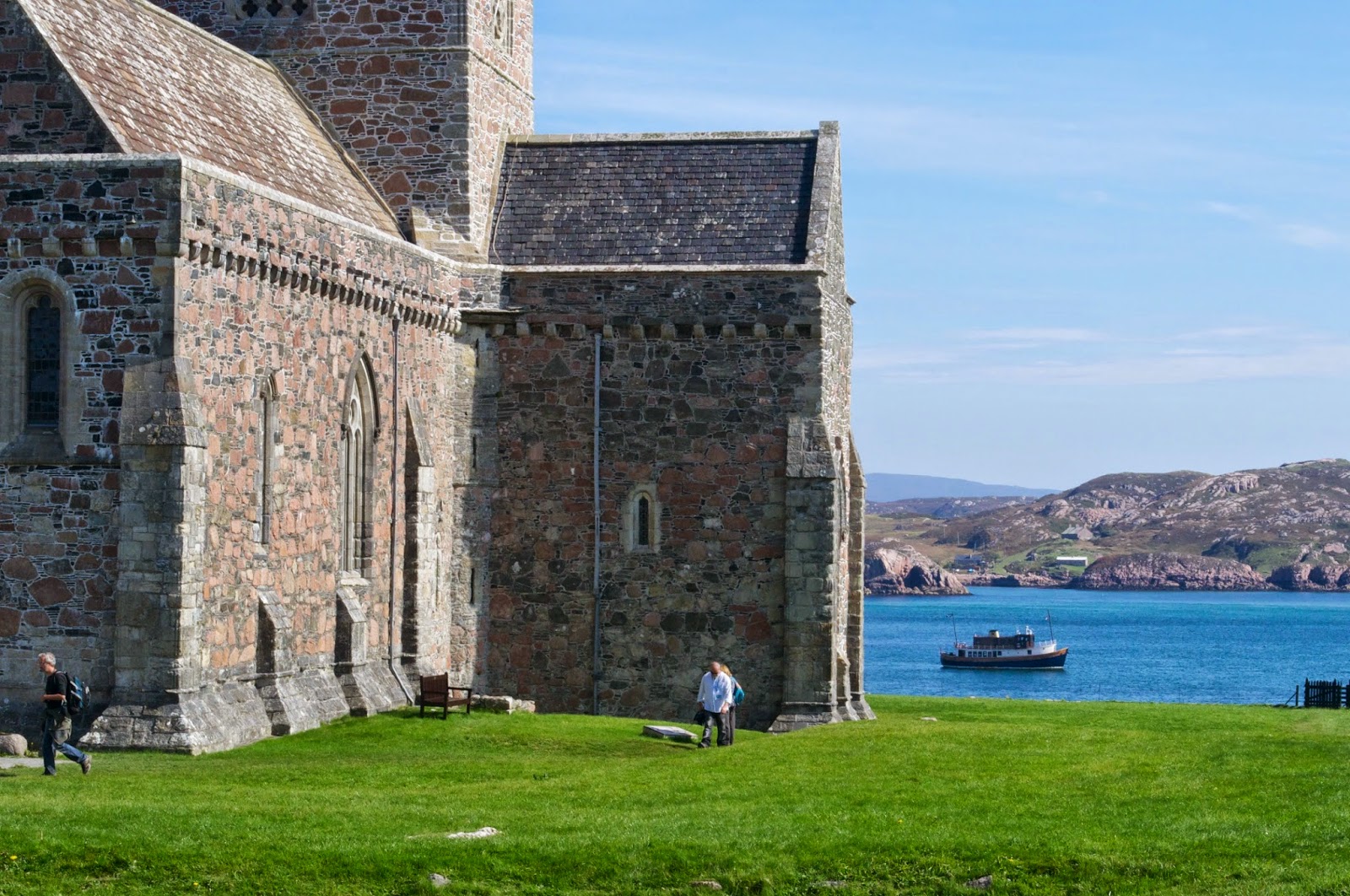
Sailed from Loch na Keal by Inchkenneth on a southwesterly course for Iona on September 10. Sea was calm with no wind, but Atlantic swells from the west. Glen Tarsen rolled quite a bit.  As we sailed into Iona we got our first view of the the island and the abbey was stunning with not a cloud in the sky. We had four hours to explore. The fittest of the passengers hiked to the west first to a sandy beach and had a swim. Chilly apparently, but worth doing.
Iona Abbey from the sea

The Iona Abbey buildings are about 300m from the jetty up a hill. The complex has been restored as it was when the Benedictines took it over with the abbey church and cloisters
St. Martin's cross
from the 8th century
taking centre stage. Two famous stone crosses are outside but there are thought to have been up to 300 in the past. The only building not restored is the bakehouse, and a charming garden with benches has been created within the stone ruins. It is a peaceful spot to rest and contemplate. The old infirmary is now an excellent museum detailing the history of the site.

Our ship anchored off the Abbey

St. Columba landed here from Ireland in 563CE and established the community and we know its layout from a chronicler in the 600s. Repeated Viking raids forced the monks out on several occasions and in the 800s they settled in Kells. In the 1200s the Benedictines took over and rebuilt the monastery and added a nunnery. The Reformation claimed Iona's Abbey and it wasn't restored until the 20th century. In the 1930s, the famed Iona Community was created and since then the sacred site has flourished as a modern place of pilgrimage.


This island on which the community was built is only 3.4 miles long. Outside the abbey visitors can wander the flower-strewn fields, the white sandy beaches with turquoise sea, or the small lanes with a few shops. Iona has been described as "a thin place" where the veil between the material world and the spiritual is like gossamer. It is certainly somewhere that put the hairs up on the back of my neck. I don't have good words to describe the place other than ancient, sacred/holy, and whispers.


From the top of the modern marble font
looking towards the altar down the nave


The abbey church dates back to the 12th century Benedictine time and is named St. Mary's Cathedral. It is Norman in style with a reconstructed Roman-esque cloister. It's not as large as cathedrals go, more the size of a parish church but it breathes faith. The Iona Community welcome pilgrims for prayer and worship and the living accommodation is on the site of the former monks' cells.

The Street of the Dead


From the Abbey, the Street of the Dead winds westward to the old cemetery where the Kings of Scotland were interred, including Macbeth and Duncan I. From 700CE the funerals processed along here to and from the church. A short portion of the street can be seen and walked along outside the abbey. Sadly the tombstones were destroyed during the Reformation and along with them, the identities of the other kings. 

After a quick look round the gift shop (good) and the ruins of the nunnery (interesting), we sailed for Bunbessin in Loch na Lathaig to anchor for dinner and the night.

Iona was definitely a bucket-list item I crossed off but four hours was not enough. I would like to come back here and stay for a couple of days and attend the abbey services.


IMAGES: © Photos by Pharos 2014. All rights reserved.

Tuesday, September 9, 2014

SMALL-SHIP CRUISING IN THE HEBRIDES (Part 4): The caves on STAFFA

On a bright cloudy but dry day, we sailed northwest around the top of Mull and felt the long Atlantic swells for the first time. We anchored for lunch in Calgary Bay, for which our Calgary is named. It's an isolated sandy bay protected by high sides.

We sailed south by Flodda, Lunga, and the oddly-shaped, low-lying Treshnish Islands and skerries that are no longer inhabited. I wondered how anyone could scratch a living here, especially in the early 20th century. They are now left to the abundant wildlife – puffins, gannets, guillimots, seals, etc. But we were really heading for Staffa.

Fingal's Cave is on the right


Staffa is the stuff of legend for here is Fingal's Cave immortalized by Mendelssohn in his Hebrides Overture. It looms out of the sea as a boxy shape, but as the ship approaches I could see the famous basalt columns of which it's made. Thousands of them in vertical rows as if a generation of stonemasons had carved them. Caves delve deep into the isle and visitors can sail into them in small boats and kayaks.


We entered Fingal's Cave in the ships tender, and it's 75m long and 20m high, and lined with hexagonal columns. Looks a bit like a cathedral nave.

We were dropped off around the east side at the jetty to walk round to the cave on a scary, narrow ledge. I chose to climb to the top for a spectacular view as I had already gone inside on the boat.


The ledge walk


Staffa and Mull are the result of ancient volcanic action. The slow cooling of lava created the basalt columns that are really huge hexagonal crystals. They make for an extraordinary sight.


From my perch on Staffa's grassy top, above and below


IMAGES: © Photos by Pharos 2014
All rights reserved

Monday, September 8, 2014

SMALL-SHIP CRUISING IN THE INNER HEBRIDES (Part 3)

Our safari van
After a quiet night anchored in Tobermory Harbour, everyone went on a full-day island safari with David Woodhouse. He is a naturalist and owns Isle of Mull Wildlife Expeditions. The safari, for that is what it was, lasted from 10am to 5:15pm. Our leader brought lunch (hot soup and sandwiches), and coffee, tea, and cake for snacks.

Looking for otters and seals
David's van is a huge 10-pax Ford and everyone has a window.   David is an
expert on birds and otters. Stopped for sea eagles (3 ft tall) and rare; deer; golden eagles (rare); Red-throated divers, the Great Northern Diver (loon), mergansers, eider ducks; and seals. Sadly the otters did not appear for us.

Isle of Inchkenneth  in the mouth
of Loch Scridain
Around every corner the views are stunning: mountains, lochs, and islands. The north coast is wild and unspoiled (machair) with strong cool winds. The east coast has more trees, thus sheltered and making it feel warmer. A whole peninsula is part of a nature conservancy area and is inaccessible by road. Only hikers can get in. 

The day was a mix of sun and cloud with a cold wind blowing, that discouraged the patience we needed to locate the rarer birds and mammals. We persevered.

Anyone who takes a tour like this needs to be aware that there are no toilets enroute, but bushes work if you can find one. If you are not passionate about birds, choose another tour that focusses on scenery and history. Either way, take thick sweaters, windproof jackets, toques, gloves and scarves. Low cut hiking boots are essential, to say nothing of binoculars and cameras with long lenses.

Mull is too big to tour in one day if you are stopping every five minutes to photograph a scenery or wildlife. 
The glen to the east

We drove south from Tobermory to:
  • Loch Na Keal and did both sides
  • Though a glen (mountain pass) to Loch Scridain with views of Inchkenneth, Ulva, Staffa, and several smaller islands.
  • Northeast via another glen to Duart Castle and Craignure.
  • Hence to Tobermory where the tender met us and took us back to Glen Tarsen.

That night the crew put on a huge, surprise birthday party for two passengers complete with decorations. The table groaned with seafood — lobsters, oysters, scallops, etc. all caught this morning. The chef even produced birthday cake with candles. The Victoria sponge with butter icing was demolished at one sitting.

IMAGES: © Photos by Pharos 2014. All rights reserved

Sunday, September 7, 2014

SMALL-SHIP CRUISING IN THE INNER HEBRIDES (Part 2)

Steaming out of Loch Sunart
Today was my first full day on the Glen Tarsen. Weather was mostly cloudy with sunny spells and a cool breeze. One sharp shower. We sailed soon after breakfast, cleared Loch Aline, ran northwest up the Sound of Mull, and then turned to starboard just past Tobermory, Mull. We steamed up the twenty miles of Loch Sunart to its head. Clouds were lifting as we anchored for lunch.

The loch's banks here are covered with trees (deciduous and evergreen) right down to the water’s edge. Behind these are some barren, rocky hillsides of machair (short  native grasses and heather).  In front of an impressive white house was a herd of red deer grazing in the parkland. 

On the banks of Loch Sunart
I spent most the time reading up about the Western Isles and getting to know the other pax better. They are all, but two,  younger than us with impressive professional backgrounds. The couple older than us were Ontarians and the rest from UK. One English couple lives in Toulouse, France. Many good discussions ensued and much humour.
 
The chef, Andie, in
her tiny galley
My first lunch was a vast cold collation with hot baked potatoes and a big slice of coffee-walnut cake.  Everything served is local, fresh produce and our chef bakes bread every day. Most passengers retired for a nap. I did not!

Instead I visited the wheelhouse and learned that this very sea-worthy vessel was originally an Irish trawler, which explains its deep draft and tubby appearance. It was built in 1975 and later sold to the Majestic Line in 2005. Then she was gutted and rebuilt as a 12-pax, 4-crew cruise ship.

The cabins are a good size, but the ensuites are only twice the size of a plane washroom. They do have a shower and lashings of hot water. We have twin beds pushed together but made-up separately. The bulkheads (walls) have many hooks to hang things on, a small closet, and shelves. There is a cubby under the bed where our baggage is stored. Beds are very firm though. Half the cabins are down below, and half are on the middle deck forward of the dining/lounge area. No Internet, very spotty cell reception, and no TV. 

A birthday buffet
We eat long table style and move where we sit so we can talk to new people at every meal. Well-stocked bar — choice of beers, wines, and some very good whiskys.

The Glen Tarsen is heading out of the sea loch as I write this and will spend the night at Tobermory on Mull anchored in the harbour.

The tender took us ashore to wander around the waterfront of this pretty town behind the harbour. Houses are multi-coloured and give hints of Norwegian style. As it was Sunday the shops were all closed, as well as the distillery. Probably just as well as I fell for a pair of earrings that were 114 pounds!

Appies and dinner were again superb, but the Highland steak was cooked too well for my taste. Lemon pot for dessert. Pax have bonded well and the meal was filled with laughter.
Tobermory harbour

IMAGES: Photos by Pharos 2014. All rights reserved

Saturday, September 6, 2014

SMALL-SHIP CRUISING IN THE INNER HEBRIDES (Part 1)

The Isle of Col
After a four-hour ferry ride from Tiree to Oban on the mainland of Scotland, we joined our home for the next week.  The ferry stops at the small island of Col and then wiggles through the islands, down the Sound of Mull, into the harbour of Oban. We had only twenty minutes to get to the meeting place in a resto on the waterfront.

Oban is bigger than I remembered it in the late '60s and felt full of tourists. Attractive waterfront. The crew took all our baggage out to the ship first and then gathered up
The Glen Tarsen in Oban
five passengers at a time for the ride out to the ship in a small tender. Just missed a sharp shower. The Glen Tarsen is one of two ships in the Majestic Line. She accommodates only twelve passengers and four crew in comfort.

After a quick briefing from the skipper and chef, we sailed. Loved the view of Duart Castle, clan home to the Macleans, which we hope to visit at the end of the cruise.
Fresh Langoustines caught off
Mull this morning


We anchored in Loch Aline, a long narrow inlet with a scattering of houses near the water’s edge clinging to steep slopes that drop into the loch. Flat calm and late day sunshine. Soon the appies arrived. The chef produced a huge bowl of Mull langoustines perfectly cooked and two canapés. I’ve never tasted better anywhere.

Dining long-table
style on board


Dinner was wild Scottish salmon wrapped in proscuitto with a pomodoro sauce and asparagus. I had halibut instead and looked with envy at the salmon. Again perfectly cooked and presented. This is going to be a foodie’s cruise. Free red or white wine with dinner! Desert was a chocolate/caramel tart, which was very French to me. Followed by a cheese board — four local cheeses. The chef told us that we will have a cheeseboard every evening. Also we will never taste the same cheeses again. Different every night. Bliss.


IMAGES: Photos by Pharos 2014. All rights reserved.


Saturday, August 30, 2014

AND WE'RE OFF!


Join me for the next month as I explore the Western Isles of Scotland and Iceland, volcano permitting.

First we visit Arran and Tiree, then the Inner Hebrides, excluding Skye. Some of this exploration is by a 12-passenger ship, and some by ferry/car.

The next stage is the Outer Hebrides and we fly into Barra, landing on the beach at low tide. Here we pick up a
car and will be touring all the islands up to Lewis, then heading from Stornaway to Iceland via Glasgow.

I have always wanted to see the Hebrides ever since I spent 2 days on Skye in 1966. So at last I'm going to!

I'll post more about our Iceland plans in a couple of weeks.